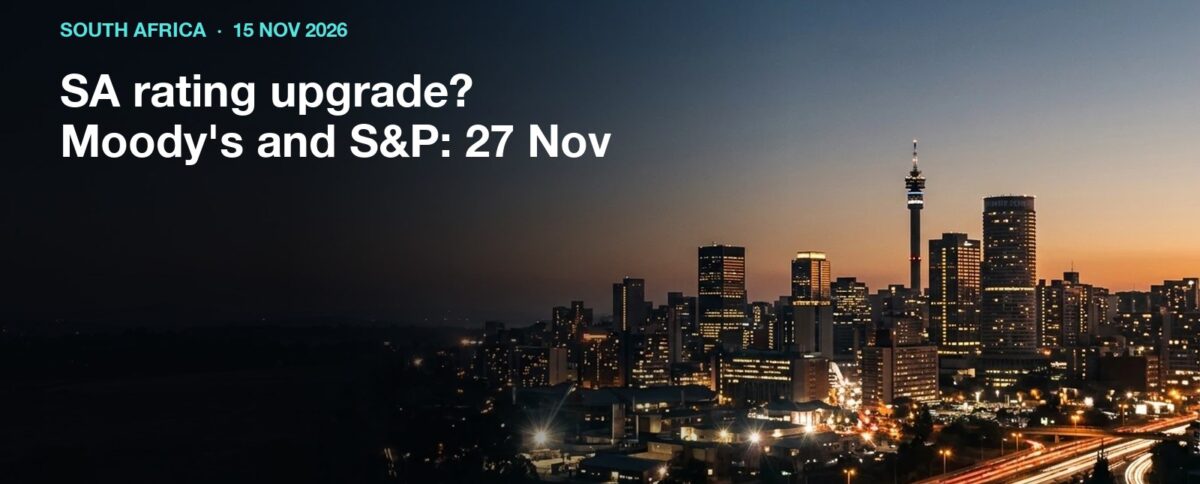
South Africa credit rating: Moody’s and S&P reviews on 27 November could bring an upgrade
South Africa could get its next credit rating upgrade on 27 November, when both Moody’s and S&P Global are scheduled to publish reviews. Both agencies have the country on a positive outlook, which signals that an upgrade is possible over the next year or so, though not guaranteed this time.
A move would be welcome news for the rand and government bonds, which have been under pressure as the dollar strengthens. It would also mark another step on a path that has already seen two upgrades in about a year.
What is South Africa’s credit rating now?
All three major agencies currently rate South Africa below investment grade, often called “junk” status, but the trend has been improving.
- Moody’s: Ba2, two notches below investment grade, with a positive outlook. Moody’s moved the outlook to positive in May, its first positive outlook on South Africa since 2007, according to the Sunday Times.
- S&P Global: BB for foreign currency debt and BB+ for local currency debt, both with a positive outlook, after a one-notch upgrade in November 2025, as summarised by law firm ENS.
- Fitch: BB, after a one-notch upgrade in June 2026.
Why could Moody’s or S&P upgrade South Africa?
Ratings agencies look mainly at a government’s ability and willingness to pay its debts. That covers economic growth, the budget deficit, the size of the debt load and how predictable policy is.
Moody’s has said publicly that South Africa is on the right track for an upgrade, Bloomberg reported in October. After the Medium-Term Budget Policy Statement later that month, Moody’s called the budget update credit positive and said the upgrade path remained intact, IOL reported.
That matters because the medium-term budget is the Treasury’s main update between full budgets. A statement that holds the line on spending and debt gives agencies evidence that targets are being met, not just promised.
What would an upgrade mean for the rand and bonds?
An upgrade usually lowers the risk premium that investors demand to hold a country’s debt. That can push bond yields down and draw in foreign money, which tends to support the currency.
The last S&P upgrade gives a guide. After it, yields on South Africa’s 2035 benchmark bond fell to record lows of about 8.60%, according to ENS analysis on Mondaq.
The rand could use the help. It slid to a seven-month low near R17 to the dollar last week, as we reported in our USD/ZAR report. Much of that weakness came from the global dollar rally rather than local news, so an upgrade would not necessarily reverse it on its own. It could, however, make the rand more resilient when risk appetite turns.
How far is South Africa from investment grade?
Investment grade starts at Baa3 on Moody’s scale and BBB- on S&P’s. From Moody’s current Ba2, South Africa needs two more upgrades to get there. On S&P’s scale, the foreign currency rating is also two notches away, while the local currency rating is one notch away.
That distinction matters. Many large pension funds and global bond indices can only hold investment-grade debt. When Moody’s cut South Africa to sub-investment grade in 2020, it was the last of the big three to do so, and the move pushed the country out of key global bond benchmarks. A Moody’s upgrade now would not restore that status immediately, but it would be a step back towards it.
Is an upgrade on 27 November certain?
No. A positive outlook means an upgrade is more likely than a downgrade over the outlook period, but an agency can keep the rating unchanged at any single review and still keep the positive outlook in place.
The Sunday Times piece framed the question as whether South Africa gets an upgrade within a year, rather than at this specific review. Traders should treat 27 November as a possible catalyst, not a sure thing. Rating agencies usually publish sovereign decisions after local markets close, so the first full market reaction would likely come on Monday 30 November.
What else is on South Africa’s calendar first?
Before the rating reviews, two big events land this week. October inflation data is due on Wednesday, and the Reserve Bank’s rate decision follows on Thursday. We preview both in our October CPI preview and our repo rate preview. A credible response to fuel-driven inflation is the kind of policy discipline agencies tend to reward.
What should traders watch?
- USD/ZAR into the 27 November announcements, and any gap at the open on 30 November.
- Government bond yields, especially the 10-year benchmark, which often moves before the currency.
- The JSE All Share index, where banks and domestic-focused stocks are most sensitive to borrowing costs.
More local market coverage is on our South Africa page.
Trade the markets you read about. Open a free WiseProp Trader account, with no deposit.
This article is for education and information only and is not financial advice. Figures are as reported by the sources linked above.