
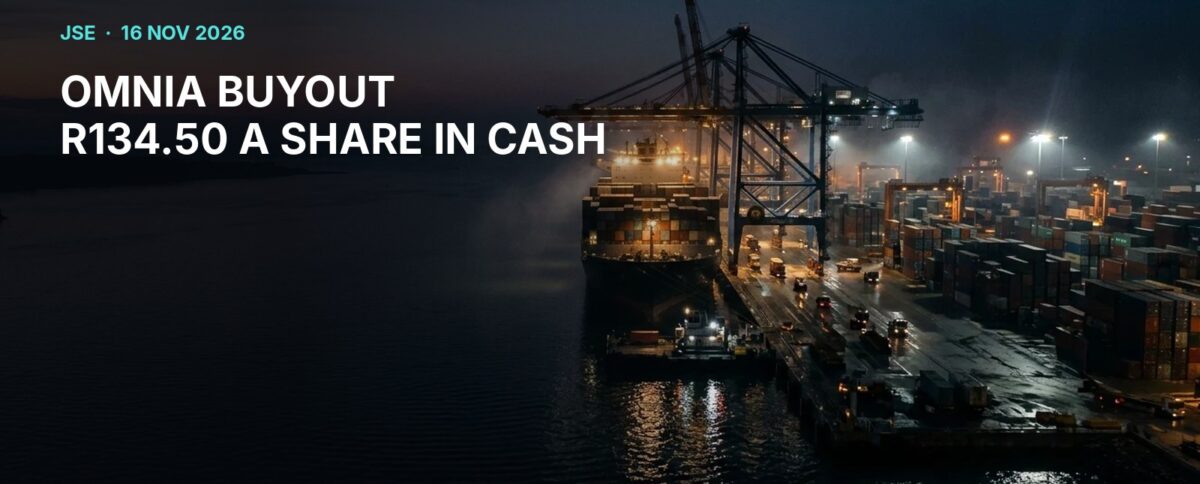
Omnia shareholders back Solar Industries’ R134.50-a-share, R21.8bn buyout by 99.97%
Omnia Holdings shareholders have approved a takeover by India’s Solar Industries that values the JSE-listed chemicals and agriculture group at about R21.8bn, with R134.50 in cash on offer for each eligible share. The deal would take Omnia off the Johannesburg exchange, BusinessTech reported.
According to the report, 99.97% of the shares voted at the 5 November meeting were in favour. That is an extraordinarily lopsided result, and it leaves little doubt about shareholder support. It is also a reminder that, for all the noise about the rand and politics, foreign buyers still see value on the JSE.
What are the terms of the Omnia deal?
As reported, Solar Industries India is paying R134.50 in cash per eligible ordinary share, for a total of roughly R21.83bn. The deal is structured as a scheme, in which shareholders vote to hand over their shares to the buyer for the offered price. When a scheme passes, the company is typically delisted once remaining approvals and conditions are met.
We have not independently verified the premium to Omnia’s pre-offer share price, nor the exact timetable for regulatory approvals, so we are not quoting them. Check the company’s JSE announcements (SENS) for the final dates.
Why does a near-unanimous vote matter?
Schemes need a large majority, usually at least 75% of votes cast, to go through. A result of 99.97% suggests that shareholders believed the price was fair and that there was little appetite to hold out for a higher bid. It also means the main risk now is regulatory, not shareholder resistance.
For minority shareholders, a cash buyout is clean. They receive the money and the stock disappears from their portfolio, which is why takeover targets usually trade close to the offer price once a deal looks likely. We explained that pattern in how acquisitions affect share prices.
What does this say about the JSE?
The JSE All Share index closed at 112,387.86 on Friday 13 November, down 0.45%, and the Top 40 closed at 104,486.62, per the Business Tech Africa daily briefing. The index is close to levels we covered in our JSE week-ahead piece.
Foreign takeovers of local companies tend to raise two debates. The first is valuation: if outside buyers are paying cash, is the market undervaluing local companies? The second is the shrinking number of listed companies, which reduces choice for local investors and is a recurring concern for the exchange.
It is not the only deal in the news. We also covered the reported ArcelorMittal South Africa and IDC talks, which shows how many strategic questions are now open across the economy.
Why would a foreign buyer want a South African company now?
We have no statement from Solar Industries in the sources we reviewed, so we will not speculate about its strategy. What can be said is that the rand has weakened, reaching about R16.99 per dollar on Monday, which makes South African assets cheaper in dollar terms for overseas buyers. We covered that move in our piece on the rand near R17. A weaker currency tends to attract bargain hunters, though it is just one factor.
What should investors watch?
- The official timetable for regulatory approvals and the delisting date.
- Any competition or foreign-investment conditions attached to the deal.
- Whether other JSE mid-caps attract similar offers.
- How the rand and political risk play out, since both affect appetite for local assets.
More local coverage sits in our South Africa hub.
What does the deal mean for retail investors and funds?
For long-term holders of Omnia, the offer converts a position into cash at a fixed price. For index and unit-trust investors, a delisting means the stock leaves their benchmark, and fund managers must find somewhere else to put the proceeds. Over time, a steady flow of cash buyouts can recycle money back into other listed South African shares, which some analysts see as supportive of the market. That depends on whether the exchange also attracts new listings.
Cash takeovers also raise a tax question for individual shareholders, since a disposal can trigger capital gains tax. This article is not tax advice, and holders should check their own position with an adviser.
It is a useful contrast with the Marvell-Lumentum deal, covered in our Marvell-Lumentum analysis, where the price was paid in shares and both stocks fell. A cash offer removes that valuation risk for the target’s holders, because the amount they receive does not depend on the buyer’s share price.
Trade the markets you read about. Open a free WiseProp Trader account, with no deposit.
This article is for education and information only and is not financial advice. Figures are as reported by the sources linked above.