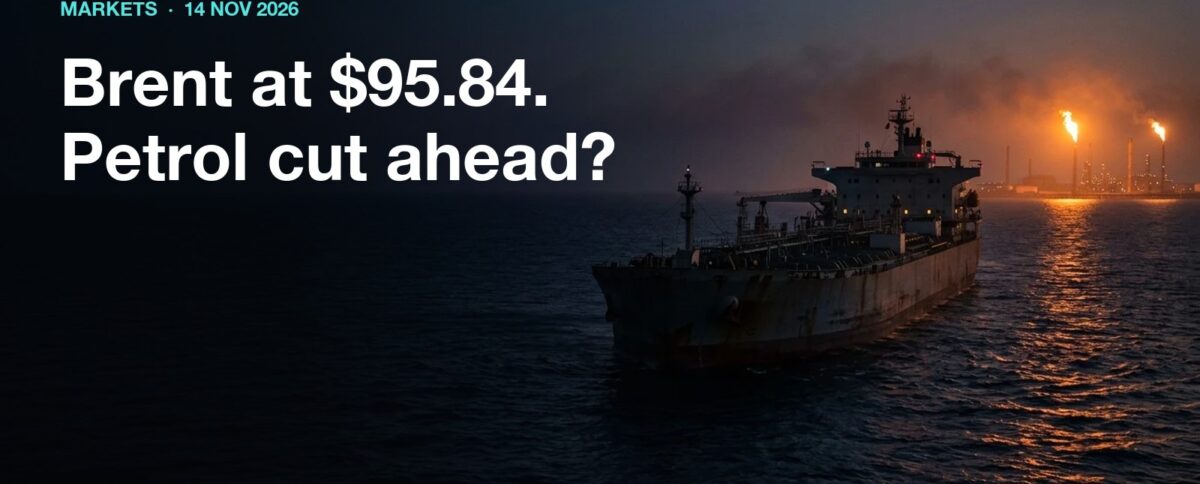
Oil price today: Brent at $95.84, WTI $88.56 after a second weekly fall
The oil price today is Friday’s closing level, because markets are shut for the weekend: Brent crude settled at $95.84 a barrel on 13 November and US West Texas Intermediate (WTI) at $88.56. Both benchmarks fell about 2.5% over the week, their second weekly decline in a row, Reuters reported.
The main reason is supply. Middle East exports are recovering faster than expected, and the International Energy Agency now expects the world to produce more oil than it uses this quarter. For drivers, that is good news: in South Africa, early data points to a meaningful petrol price cut in December.
What is the oil price today?
Brent, the global benchmark, edged up 2 cents on Friday to $95.84 a barrel, while WTI slipped 18 cents to $88.56. A week earlier Brent had settled at $98.32 and WTI at $90.83, according to EnergyNow, leaving Brent about $7.28 above WTI.
The bigger move came the week before, when Brent fell 16% and WTI 13%. Taken together, that is a sharp unwinding of the risk premium built up during the conflict with Iran. Futures reopen on Sunday evening US time, so the first fresh prices will arrive late on Sunday or early on Monday in South Africa.
Why are oil prices falling?
A supply surplus is back. The IEA said on Friday that the world oil market will return to a surplus in the fourth quarter, as Middle East exports recover faster than global demand despite continued attacks on shipping, BNN Bloomberg reported. It expects a surplus of about 3.8 million barrels a day in 2027. OPEC+ also pumped 41.23 million barrels a day in October, about 2.04 million more than in September.
Demand has softened. The IEA expects world oil demand to fall by 2.7 million barrels a day this year to 102.3 million, as high prices earlier in the year cut consumption. In the US, the Energy Information Administration said crude and fuel stockpiles rose last week, helped by weaker demand for refined products and a jump in imports.
Less fear of a shortage. Traders see less risk of a major supply shock than they did a few months ago. “It’s clear the biggest fear a few months ago was a fear of shortage,” Phil Flynn, senior analyst at Price Futures Group, told Reuters, adding that the bigger fear now is a surplus. Speculation that the Democrats’ midterm election win could speed an end to the conflict also weighed on prices, according to Bloomberg via EnergyNow.
What could push oil prices back up?
The region is not calm. Iran’s military said four tankers were hit by explosions in the Strait of Hormuz after ignoring warnings, a claim Reuters could not immediately verify. Yemen’s Houthis also said they attacked a Saudi East-West pipeline pumping station, a facility in Yanbu and an Aramco building in Riyadh. Some Gulf cargoes are still moving through Hormuz with tracking signals switched off to avoid attack.
Talks are not moving either. “There hasn’t been any change in the negotiating positions of the United States and Iran,” said Andrew Lipow, president of Lipow Oil Associates. That leaves the market caught between rising supply on one side and the chance of a fresh disruption on the other, which is why daily swings can still be large even as the weekly trend points lower.
What does the oil price mean for petrol prices?
Lower crude usually reaches the pump with a lag of a few weeks, as fuel importers and regulators work from average prices over a period rather than the daily quote.
In South Africa, fuel prices are adjusted monthly using Central Energy Fund (CEF) data, and the picture for December is positive for motorists. Data from the first week of November pointed to cuts of about R1.52 a litre for 93 petrol and R1.82 for 95, even after the government’s temporary petrol levy relief drops from R1.50 to R1.00 a litre, BusinessTech reported. More recent data reported by IOL on 12 November pointed to larger petrol cuts of around R2.35 for 93 and R2.62 for 95.
Diesel is a different story. Diesel levy relief halves from R3.00 to R1.50 a litre, so diesel is still expected to rise slightly in December. Inland 95 petrol costs R30.24 a litre in November. These are mid-month estimates, the slate levy is not included, and the final adjustment will be announced by the energy department shortly before it takes effect on Wednesday 2 December.
The rand also matters, because South Africa buys fuel in dollars. The currency has been under pressure, as covered in our USD/ZAR report on the rand’s seven-month low, and a weaker rand would trim part of the benefit from cheaper oil. A strong US dollar also tends to weigh on oil, since crude is priced in dollars.
What should traders watch next week?
Three things stand out. First, Middle East headlines, especially shipping through Hormuz and any change in talks between Washington and Tehran. Second, the weekly US inventory figures on Wednesday, which will show whether last week’s build in stocks was a one-off. Third, wider risk sentiment: Nvidia reports earnings on Tuesday and Anthropic’s IPO is due later in the week, as covered in our Nvidia earnings preview, and big moves in stocks can spill over into commodities.
For South African drivers, the next checkpoint is CEF data at the end of the month. If Brent holds in the mid-$90s and the rand stabilises, the case for a December petrol cut stays intact. For more, see our markets coverage.
Trade the markets you read about. Open a free WiseProp Trader account, with no deposit.
This article is for education and information only and is not financial advice. Figures are as reported by the sources linked above.