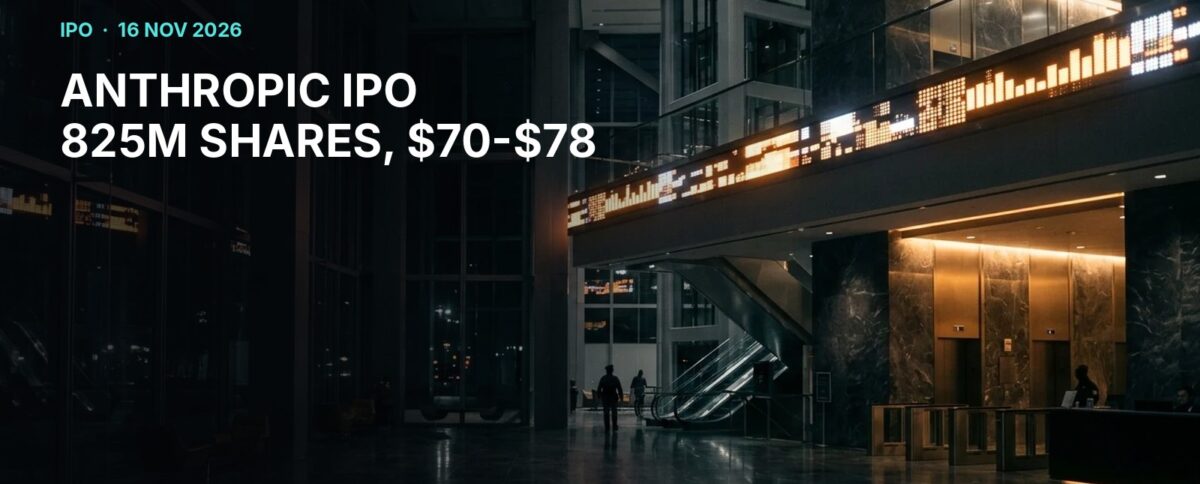
Anthropic IPO terms: 825 million shares at $70-$78 on Nasdaq as ANT, with a greenshoe
Anthropic plans to sell 825 million Class A shares at $70 to $78 each, which means a deal worth roughly $58bn to $64bn before any extra shares are sold. The shares are expected to trade on the Nasdaq under the ticker ANT, with press reports pointing to pricing on Wednesday 18 November and a first trade on Thursday 19 November.
The terms come from the company’s own roadshow announcement. The gross figure is our arithmetic (825 million shares multiplied by the low and high end of the range), not a number Anthropic has published. Our earlier pieces covered the date and price range and the $26bn private placement. This article breaks down the structure of the offering itself.
Who is selling the Anthropic shares?
Of the 825 million shares, 801,351,354 are being offered by Anthropic and 23,648,646 by existing stockholders, according to the company. Anthropic receives no proceeds from the shares sold by those stockholders.
That split is useful context. Almost all of the offering is new money for the company, with only a small slice, under 3%, being existing holders cashing out. Investors often read a low share of insider selling as a sign of confidence, though it is only one signal among many.
What is the greenshoe option?
The underwriters have a 30-day option to buy up to 123,750,000 additional shares, per the announcement. This is commonly called a greenshoe, and it lets the banks sell more stock if demand is strong, and also helps stabilise the share price after listing. Our guide on how an IPO works explains the mechanics.
If the full option were used, the share count would rise to 948.75 million. That is simple addition on the company’s figures, and it is not a forecast of what will happen.
Who are the underwriters, and what stage is the process at?
Goldman Sachs and Morgan Stanley are the underwriters named in the announcement. The S-1 registration statement was filed with the SEC on 26 October, the roadshow began on 10 November, and Anthropic has applied to list on the Nasdaq Global Select Market.
The company is explicit that the registration statement “has not yet become effective”, so the shares cannot yet be sold. Dates for pricing and trading in this article come from press reporting, as one summary notes, and have not been confirmed by Anthropic.
What valuation is being reported?
CNBC’s market coverage cites an expected valuation of about $1.4 trillion and says the debut could be a record for a public listing, in its Monday market blog. Other outlets use different bases. Some quote a fully diluted figure of $1.3 trillion to $1.4 trillion, while others calculate an implied market capitalisation closer to $1 trillion, because they count different share classes. When you see a valuation headline, check which share count it uses.
For scale, OpenAI’s last private valuation was $1.25 trillion, as we covered in OpenAI IPO: 2027 target.
Why does the timing matter for markets?
The listing lands in the same week as Nvidia’s results on Tuesday. CNBC reports that Nvidia is down about 13% on the week and that chipmakers including Micron, Intel and AMD each fell more than 5% on Monday morning. A very large AI listing absorbs a lot of investor cash, and some strategists worry that heavy supply can weigh on other tech shares around the time it happens. That is a risk, not a certainty, and the effect is hard to measure.
The opposite view is that a successful debut would be a vote of confidence in AI economics, helping the sector. Both stories will be tested within days.
What should traders watch?
- Pricing: whether the final price lands inside, above or below the $70 to $78 range.
- First-day trading: opening price versus the offer price, and trading volume.
- Nvidia on Tuesday: its results and tone may set the mood for AI stocks before ANT lists.
- Index inclusion talk: rule changes and fund flows are discussed after big listings, though nothing is guaranteed.
More deal coverage is in our Companies & Deals hub.
What does the structure tell us about demand?
An offering of this size is unusual. Raising roughly $58bn to $64bn in one transaction means the banks must place stock with a very broad set of investors, from large institutions to retail platforms. Reports of strong order books, including one that cited orders of several times the shares on offer, are encouraging, but the figure comes from a third-party analysis site and has not been confirmed by the company, so we are not relying on it.
Investors in any IPO also face practical constraints. Shares are allocated to some buyers and not others, so many retail investors will not be able to buy at the offer price and will have to decide whether to buy once trading starts. Prices in the first days can be very volatile, and a first-day jump does not tell you anything about the company’s value a year later.
For a plain-English refresher on how that works, see our guide to IPOs.
Trade the markets you read about. Open a free WiseProp Trader account, with no deposit.
This article is for education and information only and is not financial advice. Figures are as reported by the sources linked above.