
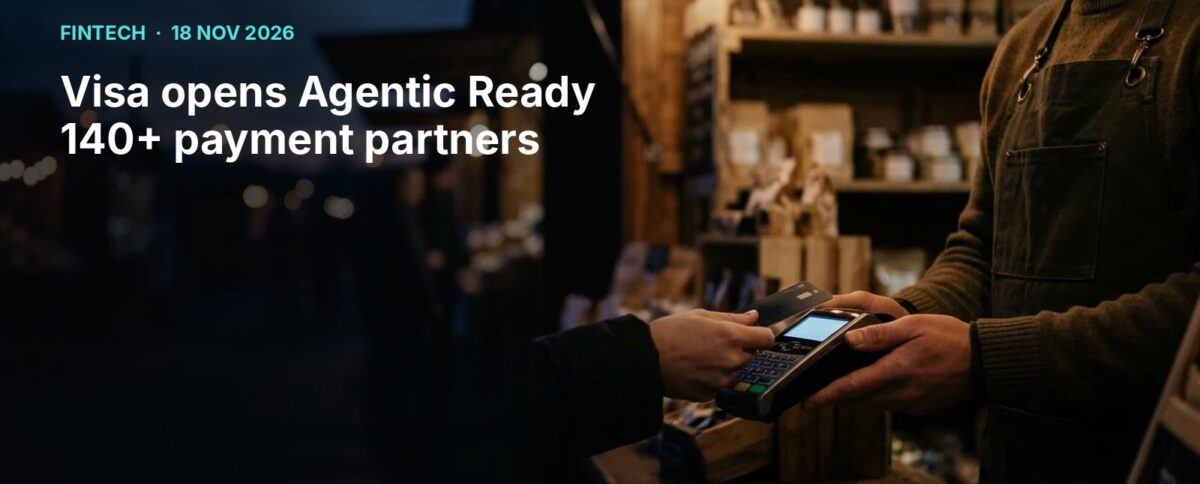
Visa expands Agentic Ready to merchants with 140+ participants, including PayPal, Stripe and Adyen
Visa has expanded its Agentic Ready programme to merchants and payment processors, launching with more than 140 participants including PayPal, Stripe, Adyen and Checkout.com. The aim is to let businesses test how payments started by AI agents are recognised, authenticated and processed on existing card infrastructure.
What is Visa Agentic Ready?
Agentic Ready is part of Visa Intelligent Commerce, the company’s effort to prepare payments for AI agents that shop and pay on a consumer’s behalf. According to a report on Visa’s announcement, the November 17 expansion extends the programme to the acceptance side: merchants, payment service providers, acquirers, commerce platforms and B2B payment providers. It gives them a shared framework to test agent-initiated transactions.
The programme’s first phase covered the issuing side, with more than 175 issuers across 45 markets testing agent-initiated transactions with their own credit and debit cards. The new phase adds the businesses that accept those payments, which is where the chain has been weakest.
Who has signed up?
The named participants, per the same report, include:
- Payment service providers: Adyen, Airwallex, Checkout.com, Fiserv, Global Payments, PayPal, Stripe, Worldline, Basis Theory and VGS.
- Acquirers and financial institutions: Antom (Ant International), dLocal, Getnet, Moneris and Spreedly.
- B2B platforms: Billtrust, HighRadius and Versapay.
Visa expects more financial institutions, merchants and enablers to join through 2027. Merchants and providers can join by contacting their Visa representative.
What problem is it trying to solve?
A card network was built around a human checking out on a screen. When an AI agent initiates the purchase, the merchant needs to know the agent is trusted, that it is acting for a real cardholder, and that the transaction is authorised. The programme focuses on four areas, according to the report: agent identity, acceptance of agentic network tokens, authentication and fraud controls, and payment routing. It also covers B2B uses such as invoice payment and reconciliation.
Rubail Birwadker, Visa’s senior vice president of growth products and partnerships, said: “No one company can solve that alone.” The long list of processors, many of them rivals, is the point of the exercise: a standard only works if the whole chain adopts it.
How does this fit with the rest of AI payments?
This is the second payments-and-AI story we have covered this month. OpenAI’s launch of a wallet that lets its agents pay with major cards was the subject of ChatGPT Wallet launches so OpenAI’s AI agents can pay with Visa, Mastercard and Amex cards. Visa’s move is the infrastructure counterpart: it focuses on how merchants will accept the payment, whichever agent starts it.
Visa is also building on the stablecoin side, as we reported in Visa adds Western Union’s USDPT stablecoin. And on the consumer side, Revolut Pay’s rollout with Uber shows how wallets are competing for checkout. For readers new to the theme, our stablecoin guide explains one of the rails involved.
What does it mean for investors?
The announcement is a programme launch, not a revenue event. Visa did not give financial targets in the report we reviewed, and PayPal’s own comment was only that it is working with Visa so its merchants can accept Visa agentic tokens, per the Seeking Alpha summary. What investors can monitor is adoption: how many participants move from testing to live transactions, and whether volumes become visible in earnings commentary.
The pattern is familiar from earlier payment shifts such as contactless and tokenised wallets: pilots first, then gradual rollout. It will take time to see whether agent-driven payments become a meaningful share of volume.
What to watch next
- Whether more South African and African processors join the programme.
- Regulatory guidance on liability when an AI agent makes a mistaken purchase.
- Competing frameworks from Mastercard and large wallets.
More payments coverage is in the fintech and payments section.
Why does merchant readiness matter?
Technology announcements from card networks are only as useful as the number of businesses that can act on them. If a shopping agent can reach a checkout but the merchant’s systems cannot tell whether the agent is legitimate, the transaction is declined, or the merchant takes on fraud risk. Getting the processors, which sit between merchants and the card networks, into the same test framework addresses that bottleneck. It also gives merchants a single place to learn what is expected of them, instead of dealing with each provider’s separate rules.
The commercial logic is clear. Card networks earn fees on transactions, and agent-driven shopping could add volume. But the programme is about trust and standards before it is about growth, and none of the sources we reviewed gives an expected size for the market.
Trade the markets you read about. Open a free WiseProp Trader account, with no deposit.
This article is for education and information only and is not financial advice. Figures are as reported by the sources linked above.